

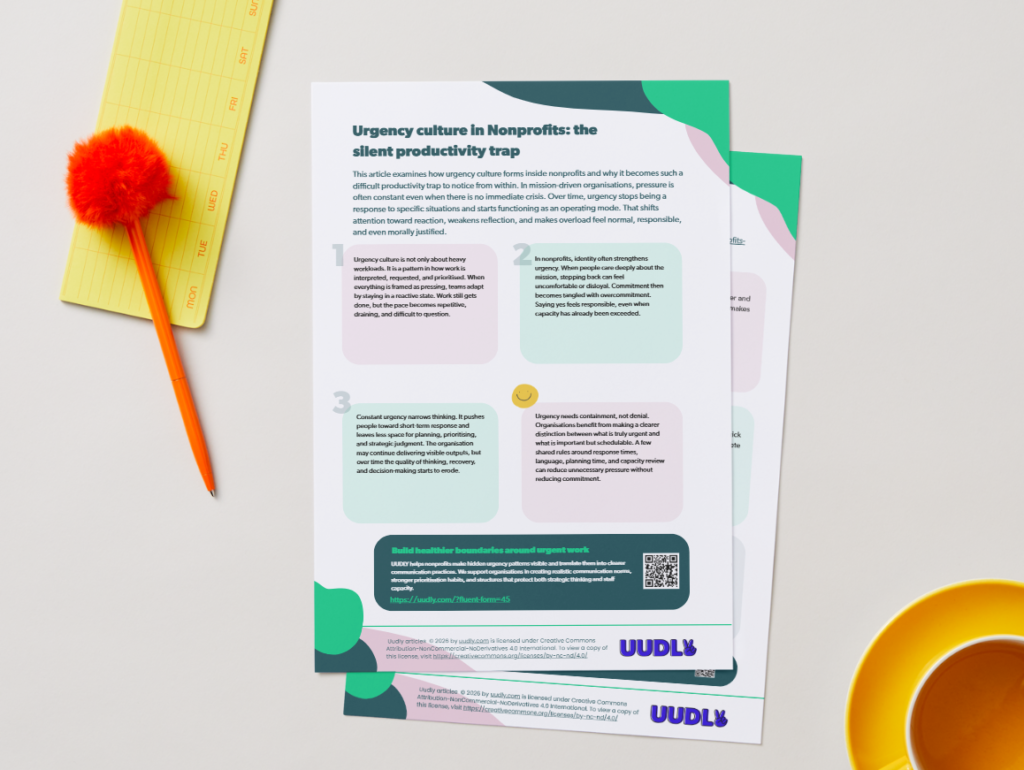
Urgency culture in Nonprofits: the silent productivity trap
Hello! This is UUDLY’s first published article. We are so excited to start writing and sharing with you about different topics and our constant learnings and experiences.
To start this blog, we could have started with trendy topics like design, social media trends or communications strategies. However, have decided to write a lot about foundational communications and we are starting with a topic close to our hearts and a challenge we keep learning about.
Over the past decade, we’ve worked with Nonprofit Organizations in different countries and contexts. We have also worked inside communications teams ourselves, coordinating, producing, managing and juggling. While sharing our personal experiences, we realized that certain tensions kept resurfacing. These tensions were not technical issues but often, they were patterns in how things were done and how decisions were made.
This series is our attempt to slow down and look at some of those patterns more carefully. Not because we believe something is broken, but because nonprofit organizations operate under very particular conditions: High values, high responsibility and very often with limited capacity. That combination creates strength, but It also creates pressure.
We are starting with urgency culture.
“Do more with less”.
In the third sector, the mission matters, funding cycles create pressure, teams are often small, the workload is heavy and the stakes feel high. What becomes harder to notice, especially from the inside, is how constant the pressure can become.
It is not always chaos, most days look functional: people attend their meetings, the reports are submitted, the applications are sent, the campaigns are launch, the programming is fulfilled, the materials are produced and the organization keeps moving. We learn to do all of this with less, even during times of expansion or high demand, but the pace rarely softens. It becomes a rhythm that repeats week after week and year after year.
Back 18 years ago when Jenn was working as communications manager in a human rights organization in Chile, she was supporting 24 parallel projects across the metropolitan region. Every week, project coordinators gathered to discuss their communications needs in a round table.
Almost every request carried a strong sense of urgency, the project coordinators spoke quickly, their tone marked by impatience, stress, and pressure, many even left before the meeting ended. Many times, they didn’t even wait for others to finish before jumping in with their own demands. After the meetings, the flow of messages didn’t slow down. The interruptions through instant chat, emails, quick questions, and update requests flooded the phone, inbox, intranet and even lunch time.
This did not happen because funding was about to collapse, because they had limited time or because there was a compliance deadline the next morning. In fact, most projects had secured annual funding, had time to develop, and autonomy to produce content at their own pace. The urgency came from internal pressure. Each coordinator had their own responsibilities, their own timelines, and their own sense that this could not wait.
Individually, every request was reasonable, but taken together, they exceeded capacity.
Producing materials for all of these projects was only part of the communications workload. There was ongoing content planning, reporting, coordination with management, maintenance work, internal communications, events, proofreading, media coverage, and the unexpected requests that appear midweek. The list did not settle but instead kept expanding.
Jenn was contracted part time. In practice, she worked full time, and weekends. One important thing to note here is that this was happening before apps and mobile phones for work even existed!
When we reflected upon this, Jenn said:
“You know what was the hardest part? It was not only the number of tasks, that kept growing in front of your eyes, but also the feeling that stopping at the end of the day felt wrong. Other colleagues were working long hours to defend all these important causes and make other peoples lives better and their communities. Closing the laptop felt like stepping away from something that was morally significant.“
No one explicitly demanded this. The pressure was not written into a working policy, it was implicit, It was cultural.
We have seen versions of this in other countries as well. The funding structures might differ, the scale differs as well as the language, but the internal dynamic often feels familiar. Highly committed people working within lean systems, coordinating through email threads, lots of meetings, instant chats, quick calls, informal conversations, and shared urgency. Let’s explore further.
The identity layer
In advocacy and Nonprofit work, values are rarely abstract. People choose this field because it aligns with who they are. There is a lot of passion and love involved in this sector. That alignment gives the work meaning, but It also complicates boundaries.
Research on identity-based motivation shows that:
People tend to act in ways that fit their sense of who they are. We are more likely to pursue goals that feel identity-consistent. Identity also influences how we interpret effort. When a task feels aligned with who we are, effort can feel purposeful. When it does not, effort can feel like evidence that we are not suited for it. (Oyserman et al., 2007).
If the cause matters deeply to us, slowing down can feel morally uncomfortable, and If others are pushing themselves, stepping away can feel like being disloyal. When the mission is part of your identity, overcommitment can feel like integrity.
Over time, urgency becomes intertwined with belonging.
What constant urgency does to thinking
There is also a physiological dimension.
Short periods of pressure can increase focus. Sustained pressure has a different effect. Research in neuroscience shows that chronic stress affects executive functioning and cognitive flexibility. These capacities allow people to plan, hold complexity, and adapt creatively (McEwen, Annual Review of Neuroscience; Arnsten, Nature Reviews Neuroscience)
So let’s put this into perspective:
An NGO where the mission becomes closely tied to people’s sense of identity but has not containment strategy in place works under sustained pressure. Urgency becomes a normal part of the organization culture. There is no clear distinction between levels of importance and urgency and every day the organization works at a fast pace. In that environment, overcommitment feels reasonable rather than excessive.
The pace rarely slows, so, people become skilled at responding to immediate demands (reactive) and less used to stepping back to reflect. (reflective). Boundaries start to shift in the name of the larger cause and saying yes feels responsible. Over time this starts affecting executive functioning and cognitive flexibility. The organization continues to deliver, and the outputs remain visible. At the same time, the space for deeper strategic thinking gradually narrows. Burnout does not appear suddenly, but develops over time as capacity is steadily reduced.
When urgency, identity-driven overcommitment, and weakened boundaries continue without interruption, burnout becomes a likely outcome.
Burnout, as defined by the World Health Organization, results from chronic workplace stress that has not been successfully managed and is classified as an occupational phenomenon rather than a medical condition.
The Center for Effective Philanthropy’s 2024 State of Nonprofits report found that 95 percent of nonprofit leaders are concerned about burnout in their organizations (CEP: https://cep.org/report/state-of-nonprofits-2024/).
In pan-European nonprofit network surveys, workload management routinely appears as the single most common “biggest challenge.”
In Nonprofit Pulse 2024 (671 nonprofit respondents across 20 European countries, with the largest shares from the UK, Germany, France, and the Netherlands), 48% cited “managing workload” as among the most challenging issues, and 31% cited “supporting staff and their wellbeing.”
Leaders often acknowledge overload and encourage balance. At the same time, calendars remain full, new commitments are accepted without a clear review of capacity, and strategic conversations are postponed when pressure increases. In practice, the operating logic of the organization does not shift.
Work in the third sector is frequently carried out with a level of intensity that resembles crisis response. Yet most organizations are not emergency rooms. When urgency becomes the default mode, it shapes behavior regardless of stated intentions.
Without structural containment, urgency sustains itself. Culture is reinforced through systems, not only through intention.
Envisioning tangible solutions: What containment can look like?
Containing urgency does not mean reducing ambition. It means creating clearer distinctions and limits. For this to work, the organization needs to separate time from the everyday rush. This can feel really hard, but it is important. Clarity and containment define the culture of your organization.
Containment involves:
- Clarifying what is truly urgent and what is important but schedulable. Language shapes the nervous systems. When everything sounds critical, everyone feels critical.
- For example: If it is not urgent or critical, it waits 24 hours, replacing “ASAP” with a concrete time. Banning dramatic phrasing unless it is truly warranted or encourage wording: “This is important, but not urgent.
- Protecting dedicated time for reflection and strategic thinking: For example: Communications strategy day every trimester.
- Setting realistic communication guidelines and recommendations that are reminded often, instead of assuming and immediate responding. For example: Supporting staff with workshops on Communication skills, Non Violent communication, Language and other types of activities that prevents working on reactive mode.
- Assessing cognitive and operational capacity with team members, before agreeing to new initiatives.
- Opening conversations about identity attachment and the difficulty of stepping back, for example, in staff meeting.
None of this removes urgency from nonprofit work. Real needs will always exist. What changes is whether urgency governs every decision.
Caring deeply about a mission does not require constant availability, because sustained impact depends on cognitive sustainability as much as financial stability.
Urgency has its place. The question is whether it has boundaries.
At UUDLY, we approach urgency culture as a systems issue. In our work with nonprofit organizations, we have seen that when structures reward speed and visible output instead of clarity, people continue to operate in reactive mode regardless of intention. Even thoughtful leadership cannot fully compensate for a system that reinforces urgency.
Over time, we have learned that meaningful change requires working on several levels at once. We begin by making urgency visible, since it often operates unquestioned. We then introduce tailored containment strategies that are realistic within nonprofit constraints. We facilitate conversations about identity and overcommitment, if needed, because culture is sustained not only by processes but by how people understand their role.
When digital systems are part of the solution, we also support them. At the same time, our experience shows that tools alone do not shift culture. They can enable change, but they cannot create it.
An organization that protects reflection time makes better decisions.
An organization that contains urgency retains knowledge.
An organization that supports boundaries sustains its people.
The issue is not whether urgency exists, but whether urgency culture, the silent productivity trap, defines the organization, or whether it is contained within clear structural boundaries.
That distinction shapes long-term impact.
References
Arnsten, A. F. T. (2009)
Stress signalling pathways that impair prefrontal cortex structure and function. “Nature Reviews Neuroscience”. https://www.nature.com/articles/nrn2648
McEwen, B. S. (2007).
Physiology and neurobiology of stress and adaptation: Central role of the brain. “Annual Review of Neuroscience”. https://www.annualreviews.org/doi/10.1146/annurev.neuro.051508.135630
Oyserman, D., Fryberg, S. A., & Yoder, N. (2007).
Identity-based motivation and health. “Journal of Personality and Social Psychology”. https://pubmed.ncbi.nlm.nih.gov/18072851/
World Health Organization. (2019).
Burn-out an occupational phenomenon. https://www.who.int/news/item/28-05-2019-burn-out-an-occupational-phenomenon-international-classification-of-diseases
Center for Effective Philanthropy. (2024).
State of Nonprofits 2024. https://cep.org/report/state-of-nonprofits-2024/
Additional resources:
Several worker-level European NGO or third-sector datasets indicate that high stress is common and that boundary erosion is a recurring feature:
Scotland’s 2025 voluntary sector workforce survey
(Over 1,300 staff and volunteers) found that 51% “frequently” experience high stress at work, 47% find it difficult to “switch off” after work, and 1 in 5 took time off in the last year due to work-related stress.
In Northern Ireland, NICVA’s 2024 workforce research
(245 staff survey responses plus focus groups) reports that 47.8% of participants said high burnout levels make staff retention challenging, and it links burnout risk to excessive workload, high demand with insufficient resources, and job insecurity from short-term contracts.
In France’s social and solidarity economy (ESS), Chorum’s national quality-of-working-life barometer
(5,467 employees and leaders) reports that 50% of employees say their workload is excessive and that 77% of leaders are often connected outside working time, consistent with boundary erosion and “always-on” expectations.
Peer-reviewed studies demonstrate how burnout burden spikes in high-intensity NGO contexts:
Spain
Among third-sector social action workers (n=141), 10.85% met “critical burnout” criteria (profile 1) and 1.55% met “critical burnout plus guilt” criteria (profile 2); 30.16% screened positive for psychological morbidity (GHQ-12).
Greece
(Lesvos, 2016 refugee crisis): 57% of rescue workers reported burnout syndrome; the study explicitly includes responders from NGOs such as the Hellenic Red Cross and others operating on the island.
Italy
Among Italian Red Cross volunteers (n=241), 35.9% scored in the highest tertile for depersonalization (MBI), and emergency-care volunteers reported worse burnout-related subscale scores than those in non-healthcare social or administrative duties.
Free work clarity toolkit
Ready to change things?
Download our worksheet and start taking concrete steps into an organization or business that is healthier, more aligned and with better communication.
Add your first comment to this post