

The snowball of self-sacrifice: When doing good comes at a cost
6 minutes read time.
In the previous post on urgency culture, we explored how pace becomes normal in nonprofit work, even when there is no immediate crisis. We also touched on identity because when the mission matters deeply, stopping can feel morally uncomfortable, and pushing through can start to feel like integrity. In this post we go one layer deeper into that identity layer, because it is often where self-sacrifice begins.
Previous post: Urgency culture in Nonprofits: the silent productivity trap
https://uudly.com/en/communications/leadership-culture/urgency-culture-in-nonprofits-the-silent-productivity-trap/
The perception of effort
In organizations that help people, work is rarely just employment. It is a personal commitment and values appear in everyday details. For example on how communities are described, how funding applications are written, the care placed into a campaign, the way people remain available because needs feel immediate. This type of alignment creates meaning, but also changes what effort feels like.
Research on identity-based motivation shows that people are more likely to persist when a task feels aligned with who they are. Putting into context: Your efforts can feel purposeful when they match your identity (Oyserman, Fryberg & Yoder, 2007). This can change the starting conditions on how work is perceived. For example, working late does not feel like extra work, skipping a break does not feel like a choice, or saying yes does not feel like crossing a boundary, even when you already have a lot on your table but instead, It feels like you are doing what feels right.
Self-sacrifice rarely begins with a dramatic decision. It usually grows out of small, practical compromises that feel reasonable in the moment. For example: a hobby is postponed because there is no time this month, or a dinner with a friend is cancelled because a report must be finished. Each decision makes sense in isolation. Over time, however, these trades remove the very factors that support resilience.
Mental health in the scope
In mental health practice, protective factors refer to everyday activities and relationships that help people cope under strain. They are not luxuries. They stabilize you. Regular sleep and meals, movement and time outdoors, hobbies unrelated to work, friendships outside professional networks, family time without multitasking, and quiet time where the nervous system can settle all play this role.
Under pressure, these are usually the first to disappear, and it is not because anyone formally requires it, but because stress narrows our attention. Work shifts into survival mode and that is where the snowball begins to gather weight.
Nonprofit organizations frequently operate with limited funding, short cycles, and small teams. As described in the urgency culture post, lean structures combined with high responsibility create ongoing strain. When this strain meets strong identity-based commitment, a familiar pattern can emerge: passion combined with limited resources turns into quiet martyrdom. Not dramatic self-sacrifice, but gradual overextension.
Consider a small advocacy organisation preparing a major funding application: A deadline is fixed and the team is already stretched. No one wants to submit something unfinished because the cause matters to them a lot, so evenings become normal working hours and weekends are used “just this once.” Everything else is postponed.
The application is submitted, relief lasts for a brief moment and ten the next campaign begins. Nothing feels extreme but recovery never quite happens. This dynamic is not only organisational, It reflects a broader cultural pattern.
Self-pressure beyond the individual
Byung-Chul Han describes contemporary work culture as one in which people internalize performance pressure. In Psychopolitics, he writes: that “The exploited is at the same time the exploiter.” (Han, 2017). He also mentions in his famous book the Burnout Society, that “The achievement-subject gives itself over to freedom of constraint, or free constraint, in order to maximize performance.” (Han, 2015)
For example, a program coordinator at a small mental health NGO deeply believes in the organization’s mission. When funding cuts reduce staff capacity, no one explicitly asks them to work longer hours. Still, they start answering emails late at night, taking on additional tasks, and skipping breaks because they feel responsible for the people the organization serves.
Over time, the pressure is no longer external. The coordinator pushes themselves to do more, believing that slowing down would mean failing the community. In this situation, the person is both the one being exploited and the one sustaining the exploitation. The drive to perform comes from within, shaped by commitment to the mission rather than direct managerial pressure.
This is the dynamic Han describes: performance pressure becomes internalized, and people freely impose constraints on themselves in order to keep contributing. These ideas resonate in mission-driven environments because pressure is easily interpreted as commitment.
Self-sacrifice does not remain individual for long. It becomes cultural. If one person regularly replies at 22:30, this gradually sets a norm and If overwork is praised as dedication, boundaries appear less committed. Plainly: if everyone is stretched, speaking about limits feels uncomfortable.
When we raise awareness about this we are not talking about fragile individuals, it is about accumulated structural pressure that slowly breaks the individual.
Containing the snowball
Breaking this cycle does not require guilt. Instead of bringing awareness of it without separating time to fix it, it requires gentle containment. Containment is not a quick solution or a checklist, containment is a structural adjustment that protects long-term capacity, therefore it needs to be prioritized more.
Rest, relationships, and recovery are often framed as personal matters, but in reality, they are part of organizational sustainability, because stepping away does not mean stepping away from the mission. It means we are maintaining the conditions that allow the mission to continue.
Clear distinctions also help:
What is treated as urgent because urgency is being manufactured?
What is treated as urgent because alarm is being created around it?
What is made to feel urgent through pressure rather than need?
What is framed as urgent in order to force a response?
What is made urgent, not because it is critical, but because urgency is being used to pressure attention toward certain priorities?
When we describe everything as critical, the nervous systems remain on alert. The way we use our language influences perception, and perception influences stress.
How to make practical agreements simple?
Practical agreements do not need to be complicated but need to be agreed. It will help us understand what is really urgent and what is performative. To make this clear: these measures do not reduce commitment, they stabilize it.
For example:
- No expectation of responses outside agreed hours.
- Replacing the famous and overuse ASAP “as soon as possible” with specific timelines and clear handovers so responsibility is shared.
- Recovery time after intense periods.
- Feedback sessions.
When we are able to discuss pace without turning the conversation into a moral debate, we know that our organizations are placing important limits. People working in this sector carry care, skill, and complexity, but without containment, that complexity is reduced to output. Our commitment is renewable, but not infinitely, it depends on recovery.
How UUDLY can help
At UUDLY, burnout patterns are approached as systemically rather than as personal weaknesses, and we don’t focus on individual resilience training, but on helping with structural clarity. While working closely with nonprofit teams has show us that pressure often accumulates in invisible ways such as unclear priorities, unrealistic storytelling expectations, overlapping responsibilities, and unexamined urgency language.
We support organizations by making these patterns visible and workable. for example creating facilitated sessions that surface hidden workload dynamics, clarifying what communication capacity can realistically hold, aligning storytelling with available resources, and establishing practical agreements that support sustainable pace The aim with these is not to lower ambition, but to build communication structures that can carry ambition over time.
Self-sacrifice often begins with genuine care. In most nonprofits, the question is not whether people care enough, the question we are raising is whether the system makes that care sustainable.
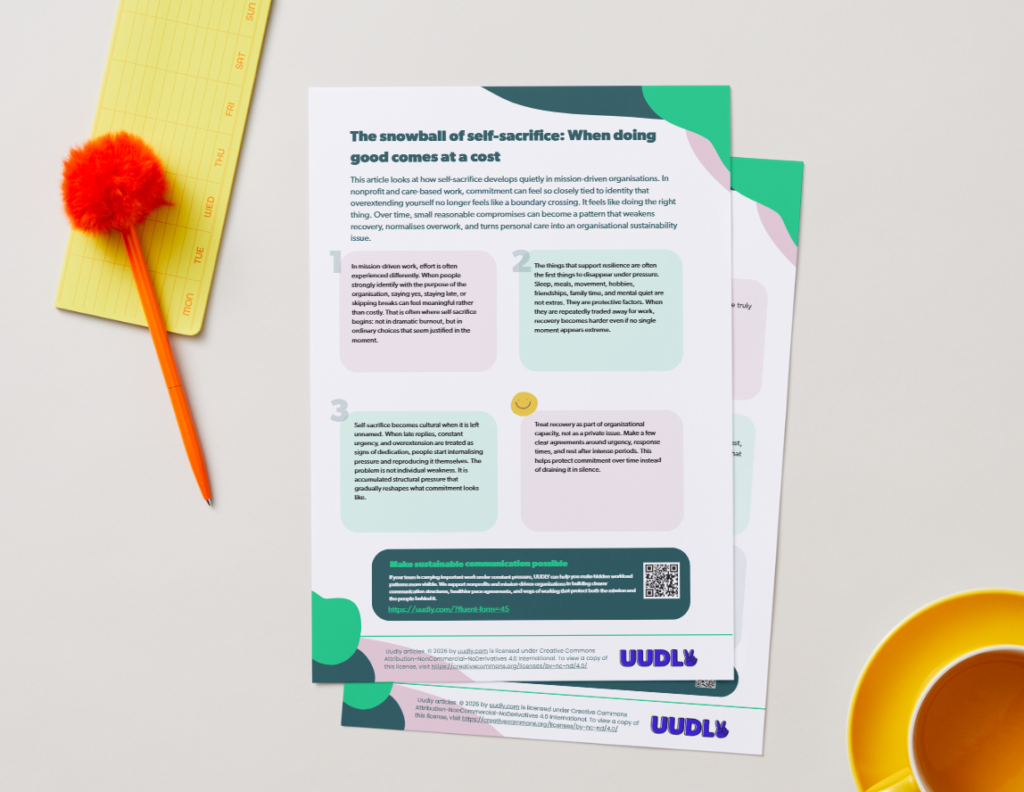
A free toolkit to help you organize your work
Are you ready to make changes?Download our toolkit and take concrete steps toward a healthier, more cohesive, and better-communicating organization or company.
Add your first comment to this post