

Boards, Consensus, and Delegation: When Horizontal Becomes Paralysis
In many advocacy organizations, NGOs, collectives, grassroots groups, and community-led projects, horizontality is not just a governance model, it is tied to the deeper desire to avoid repeating the kinds of power structures that have already caused harm. This is beautiful and reflects a commitment to shared voice, participation, and collective ownership.
We love horizontality, we find that is a lot easier to work with people who value, respect and understand that everyone’s input is important. When people feel safe to speak, contribute, and shape direction together, the work tends to become more sustainable, more ethical, and more honest because it gives people the psychological safety to be their true selves. They are part of what makes the work possible in the first place.
We also need to be honest, there is also a quieter tension that shows up in a lot of teams like this, specially when meetings run long, it takes very long to come up with a decision, the task get discussed over and over, but no one leaves with a clear understanding of who is doing what. We’ve been there, and many of the organizations we work with have been there too. Everyone cares deeply, everyone wants to contribute, but oh boy it takes long to get things done! 😆
When we read this nice book called Come Hell or High Water: A Handbook on Collective Process Gone Awry by Delfina Vannucci & Richard Singer we understood that when responsibilities and processes stay vague, groups do not automatically become more equal. In practice, a small core of people often ends up carrying more than everyone else, because they pick things up, follow things through, hold the context, and keep the work moving simply because someone has to. Reality check: if responsibility is shared in theory but not clear in practice, it often stops feeling shared at all.
Another useful point in the book is about accountability. In many collectives, there is no single manager holding the whole thing together. This means that the structure itself has to do some of that work, because people need clarity on how decisions are made, who takes responsibility for what, and how the group responds when things begin to slip.
Important to clarify: This does not mean becoming rigid or hierarchical, It just means giving the collective enough structure to function well under real conditions. Because when roles stay blurry and follow through depends on whoever has the most energy that week, even the most value led group can start to feel frustrating, heavy, or quietly unfair. Collective work needs trust, and trust works better when it has something solid to lean on. A bit more clarity around roles, decisions, and responsibility does not weaken shared ownership, it protect it.
Consensus and its limits
Participatory decision-making matters, and research backs that up. When people feel heard and involved, they tend to be more committed, and decisions are more likely to feel fair and legitimate (Cotton et al., 1988; Kim & Mauborgne, 1998). In advocacy and community work, that matters a lot, but let’s be honest: participation and consensus are not the same thing. As groups grow, decisions often get slower, especially when every step depends on full agreement.
When responsibility is spread very widely, people can become less likely to take initiative or step forward clearly (Kerr & Tindale, 2004; Latané & Darley, 1968). We have seen that pattern too. What begins as collective ownership can, over time, start to feel more like collective hesitation. In nonprofit governance and voluntary organizations, researchers have found that when process clarity is weak, more energy goes into holding the discussion than advancing the mission itself (Ostrower & Stone, 2006). No one means for progress to stall in purpose, but when there is not enough clarity around how things move, discussion can quietly become the work itself.
dline, other urgencies gradually take precedence. Structure does not undermine collective work. It protects it.
When ideas replace responsibility
Sometimes in these type of dynamics, there are a lot of ideas, new initiatives and conversations can go into many tangents during meetings. All of this is because of the enthusiasm and care that is felt for whatever the cause is. However, there is one pattern we have recognized as well: idea generation is not matched by ownership, so often new ideas are introduced without commitment to execution increasing cognitive and emotional load for the group.
Some research on social loafing gives language to something a lot of collective teams eventually run into: when ownership is too loose and contributions are hard to see, effort rarely stays evenly shared (Karau & Williams, 1993). We’ve seen this ourselves, over time, a smaller group often ends up carrying the practical side of the work, while others stay closer to the ideas, the discussion, or the intention behind it. Imagining is lighter than implementing, suggesting something in a meeting carries less weight than actually holding it through the first stage.
Ideas connected to commitment: how do we protect our communities from social loafing?
A few clear and cost free ways are:
- If someone proposes an initiative, they also take responsibility for shaping its first step. (Kind of like a project manager responsible for defining the scope, naming the next actions, and reporting back within an agreed timeframe).
- If the capacity is not there, that is okay too. This shows that the organization or collective is mature enough to postpone a proposal until someone is genuinely able to carry it.
Next steps for organizations and collectives
To wrap-up this blogpost we want to to introduce a few forms of containment that make collective work more honest, fair, and sustainable:
- Defining which decisions need full group input and which can be made by a smaller working group or a clearly named person.
- Ending meetings with explicit ownership. For example: Who is doing what, when, and how will the group know it happened?
- Creating a simple rule that if someone proposes a new initiative, they also hold responsibility for shaping the first steps.
- Normalizing to postpone when capacity is not there. Delaying an idea can be a sign of maturity, not failure.
- Reviewing where invisible labor is accumulating. Who is consistently following up, holding context, or carrying unfinished tasks?
How UUDLY can help
Here at UUDLY we support you in finding kind of clarity that protects both people and purpose by creating practical clarity without flattening the spirit of the work. Booking some sessions with us can help you regain perspective for example clarify roles and responsibilities, Improve meeting and decision-making flow, reduce ambiguity around follow-through, create healthier ownership of ideas and initiatives or strengthen communication structures so fewer things get lost between intention and action
We help by building structures that support your work without forcing it into rigid systems or corporate language. We help people who help people, which in practice means creating ways of working that are humane, realistic, and genuinely aligned with how your organization actually functions..
The goal is not more control. It is less confusion, less hidden overload, and more shared responsibility in practice. For many teams, that kind of clarity creates immediate relief and it helps meetings become more useful, to have cleared decisions, and to have commitments that feel more grounded. Over time, this protects capacity and it gives the collective something solid to lean on.
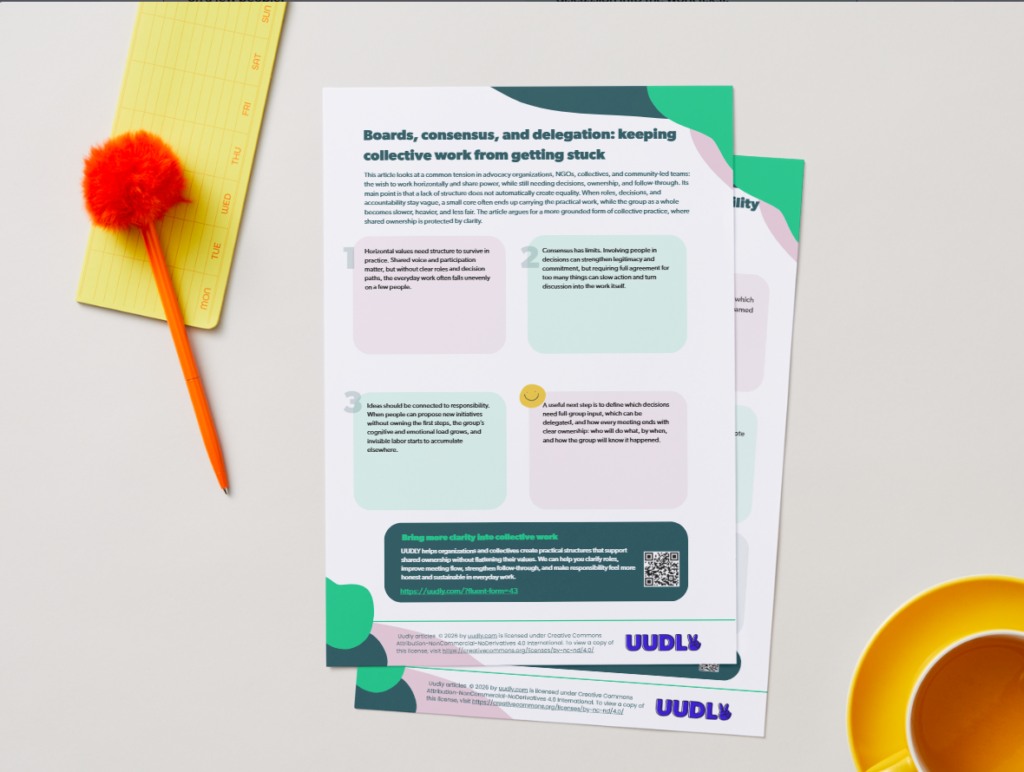
Free clarity worksheet for you and your team members
Ready to change things?
Download our worksheet and start taking concrete steps into an organization or business that is healthier, more aligned and with better communication.
Add your first comment to this post